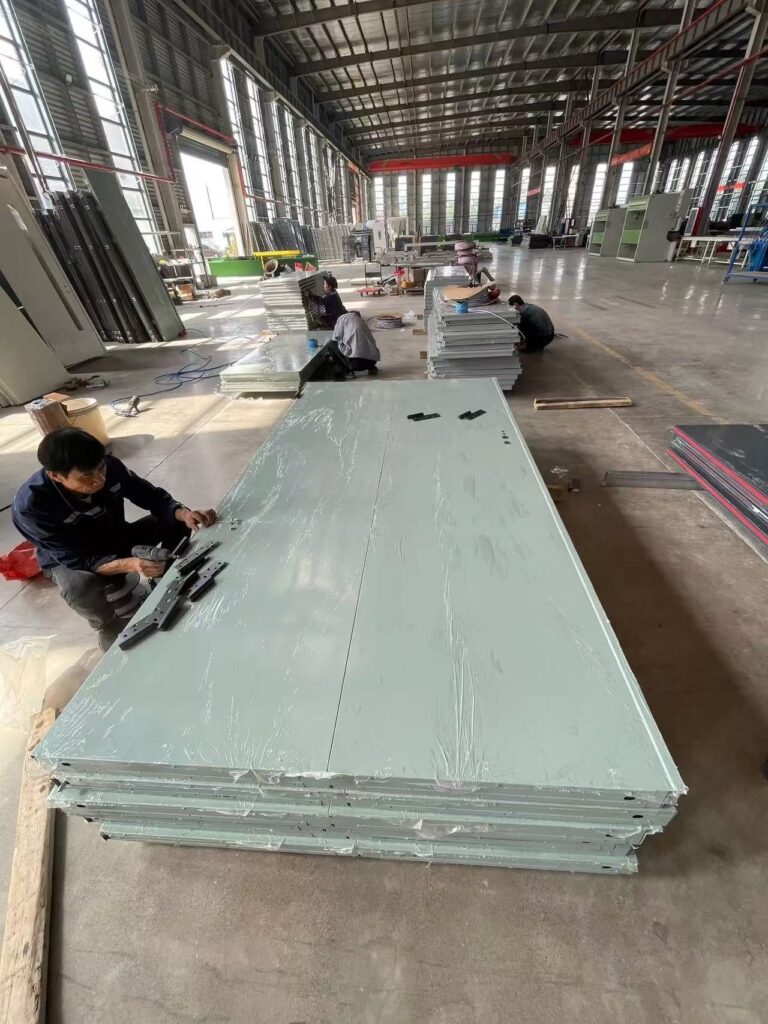
First, the conclusion: Steel fire door plate thickness is not “the thicker the better,” but rather “the thicker the more expensive, yet it must clear the baseline.” This baseline is strictly locked by the national standard GB 12955, and the 2024 edition is stricter than the 2008 version.
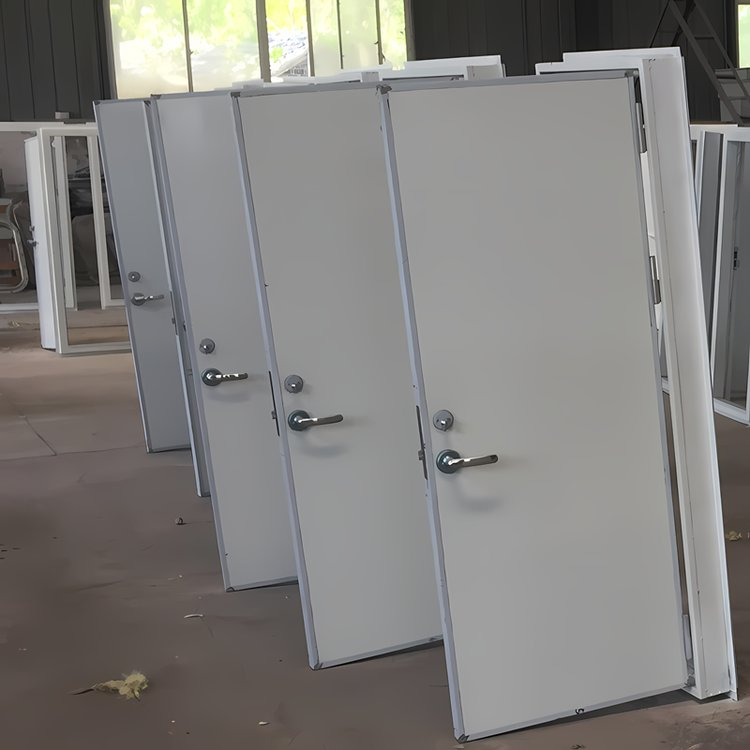
Below, I will thoroughly explain steel plate thickness from three dimensions: standard clauses, component breakdown, and acceptance inspection measurement.
I. Current Core Standard: The Rigid Baseline of GB 12955-2024
The sole legal basis for steel fire door plate thickness in China is GB 12955-2024 “Fire Doors.” Issued in October 2024, this standard refines the thickness requirements for steel materials by grade. The core logic is: the higher the fire resistance requirement, the thicker the steel plate.
According to Annex C of the standard (Nominal Thickness Requirements for Steel Materials), steel plate thickness is divided into two tiers based on whether fire resistance performance exceeds 1.5 hours:
| Component Name | Fire Resistance > 1.5h (A2.0 / A3.0, etc.) | Fire Resistance ≤ 1.5h (A0.5 / A1.0 / A1.5, etc.) |
|---|---|---|
| Door Frame | ≥1.5 mm | ≥1.2 mm |
| Door Leaf Panel | ≥1.0 mm (inferred from standard logic) | ≥0.8 mm |
| Door Leaf Skeleton | Higher requirements | Basic requirements |
Note: The 2024 edition classifies fire doors into Category A (insulated), Category B (partially insulated), and Category C (non-insulated) by fire resistance performance. Therefore, “A1.5” in the table refers to Category A insulated for 1.5 hours.
At the same time, the standard sets absolute baselines for key load-bearing / connection areas, which do not change with fire rating:
| Component | Material Thickness Baseline |
|---|---|
| Hinge Plate | ≥3.0 mm |
| Reinforcement without Screw Holes | ≥1.2 mm |
| Reinforcement with Screw Holes | ≥3.0 mm |
Material Requirements
Steel plates must be cold-rolled thin steel plates with performance no lower than that specified in GB/T 708; reinforcements may use hot-rolled steel no lower than GB/T 709. This means “fire doors” made from recycled scrap iron or color-steel tile offcuts on the market are non-compliant from the material source.
II. Thickness Breakdown of Six Major Components
1. Door Frame
The door frame is the “skeleton” of the entire door, bearing the weight of the door leaf, the pull force of the door closer, and structural deformation stress during a fire.
- Routine baseline: ≥1.2 mm (corresponding to Class B, Class C, and ordinary Class A doors)
- High fire resistance grade: ≥1.5 mm (corresponding to doors with fire resistance rating > 1.5 hours, such as some A2.0 and A3.0 fire doors)
Engineering common sense: Door frame material is usually not a flat plate, but rather a profile formed by cold-roll forming. After forming, local thickness may be slightly reduced due to bending, so the nominal thickness of the raw material must include sufficient margin.
2. Door Leaf Panel
The door leaf panel is the “first line of defense” directly facing flames during a fire, and it also determines the door’s flatness and impact resistance.
- Baseline: ≥0.8 mm (universal baseline in GB 12955-2008 / 2024)
- Premium market practice: Class A doors commonly use 1.0–1.2 mm; Class B doors commonly use 0.8–1.0 mm
Note: 0.8 mm is the “nominal thickness,” and permissible deviation must comply with GB/T 708. In actual acceptance inspection, a caliper reading of 0.75 mm does not necessarily mean rejection, but if it’s only 0.6 mm, it’s basically confirmed corner-cutting.
3. Door Leaf Skeleton
The internal skeleton of the door leaf (side rails, horizontal rails, vertical rails) supports the panels and accommodates fire-resistant infill material.
- The standard does not separately list a baseline thickness for the skeleton, but industry convention aligns it with reinforcement, typically ≥1.2 mm.
- For oversized door leaves (e.g., width > 1500 mm), the skeleton needs denser or thicker reinforcement to prevent flexural deformation under high temperatures.
4. Reinforcement
Reinforcements are local strengthening plates inside the door leaf used for installing hardware such as locks, door closers, and sequencers.
- Reinforcement without screw holes: ≥1.2 mm
- Reinforcement with screw holes: ≥3.0 mm
Why 3.0 mm for screw holes? Because screw bite force requires material thickness to support it. After tapping, a 1.2 mm steel plate has insufficient remaining thread height; under high fire temperatures, hardware can easily detach and cause door leaf failure. This clause was written with bloody fire lessons.
5. Hinge Plate
The hinge plate connects the door leaf to the door frame and is the most vulnerable mechanical node of the entire door.
- Baseline: ≥3.0 mm
The direct consequence of insufficient hinge plate thickness: during a fire, the door leaf sags and jams, preventing people from pushing it open; or the door leaf completely detaches after high-temperature deformation, instantly compromising the fire compartment.
6. Vision Panel Bead
If the door leaf has a fire-resistant glass vision panel, the steel bead holding the glass typically requires a thickness of ≥1.0 mm and must pass fire integrity testing to prevent the glass edge from shattering due to uneven temperature rise.
III. Door Leaf “Overall Thickness” vs. “Steel Plate Thickness”: Don’t Confuse the Two
Many people conflate “door leaf overall thickness of 50 mm” with “steel plate thickness of 0.8 mm.” These are completely different indicators:
| Concept | Meaning | Common Class A Value | Common Class B Value | Common Class C Value |
|---|---|---|---|---|
| Door Leaf Overall Thickness | Overall cross-section height of the door leaf, including steel plates + infill layer | 50–55 mm (some manufacturers make 66 mm) | 45–50 mm | 40–45 mm |
| Panel Steel Plate Thickness | Single-layer panel thickness of the front and rear steel plates | 0.8–1.2 mm | 0.8–1.0 mm | 0.6–0.8 mm |
| Infill Layer Thickness | Net thickness of perlite board / aluminum silicate fiber | Approx. 48 mm | Approx. 43–45 mm | Approx. 38–40 mm |
Door leaf overall thickness is determined by fire resistance rating and insulation, while steel plate thickness is determined by structural strength and fire integrity. Both work together; neither can be omitted.
IV. Key Upgrades in the 2024 Edition (Compared to the 2008 Edition)
If you still have inventory doors produced to GB 12955-2008, note the following changes:
| Dimension | GB 12955-2008 | GB 12955-2024 |
|---|---|---|
| Door Frame Thickness | Uniform ≥1.2 mm | Tiered: >1.5h requires ≥1.5 mm; ≤1.5h requires ≥1.2 mm |
| Smoke Tightness | No mandatory requirement | Mandatory: ≤20 m³/h for single leaf, ≤30 m³/h for double leaf at 25 Pa |
| Hose Stream Test | None | Required for doors with fire resistance ≥60 minutes |
| Fire Resistance Classification | Only Class A / B / C three grades | Added Category A / B / C (insulated / partially insulated / non-insulated), covering 0.5h–3.0h |
| Deviation Measurement | Not specified | Explicitly specifies ultrasonic thickness gauge / caliper / micrometer, with defined measurement points |
The two toughest new clauses in the 2024 edition: hose stream test and smoke tightness. This means simply making the steel plate thicker is not enough; seam sealing, weld quality, and hardware fire resistance must all improve holistically.
V. On-Site Acceptance: How to Measure? Where to Measure?
During fire protection acceptance or supervisor patrols, steel plate thickness measurement follows standard methods—not just randomly poking a corner:
Measurement Tools
- Ultrasonic thickness gauge (precision 0.01 mm, preferred, non-destructive to surface)
- Vernier caliper (precision 0.02 mm, requires disassembling the door leaf or using existing openings)
- Micrometer (precision 0.01 mm, used for small samples)
Measurement Points (as specified in GB 12955-2024)
- Door leaf panel: Measure at the midpoint of any three edges, take the average of three points.
- Door frame: Measure at the midpoint of each frame member (top frame, both side frames), take the average.
- Deviation determination: Actual thickness deviation from nominal thickness must comply with the permissible deviation table in GB/T 708 or GB/T 709.
Common Acceptance “Tricks”
- Thick frame, thin panel: Door frame uses 1.5 mm, but door leaf panel is only 0.6 mm, so overall fire resistance is non-compliant.
- Local thickening, overall thinning: Hinge plates and lock areas locally use 3.0 mm, while other reinforcements use 0.8 mm to cut corners.
- Substituting galvanized plate for cold-rolled thin steel plate: Galvanized plates have good corrosion resistance, but under high fire temperatures the zinc layer melts and accelerates steel plate deformation, failing the GB/T 708 material requirement.
- Infill layer skimping: Steel plate thickness is sufficient, but internal perlite board density is insufficient or thickness is lacking, causing insulation failure.
VI. Matching Logic Between Thickness and Fire Resistance Rating
Finally, here is a quick-reference table for engineering selection, convenient for designers and purchasers to check directly:
| Fire Resistance Grade | Fire Resistance Rating | Door Frame Steel Plate | Door Leaf Panel | Door Leaf Overall Thickness | Typical Scenarios |
|---|---|---|---|---|---|
| Class C | ≥0.5h | ≥1.2 mm | ≥0.8 mm | ≥40 mm | Pipe shafts, cable shafts |
| Class B | ≥1.0h | ≥1.2 mm | ≥0.8 mm | ≥45 mm | Evacuation corridors, stairwells |
| Class A | ≥1.5h | ≥1.2 mm (routine) ≥1.5 mm (high-spec) | ≥0.8 mm (baseline) ≥1.0 mm (recommended) | ≥45 mm (baseline) 50–55 mm (common) | Fire walls, electrical rooms, equipment rooms |
| A2.0 / A3.0 | ≥2.0h / 3.0h | ≥1.5 mm | ≥1.0 mm | ≥55–66 mm | Boiler rooms, gas machine rooms, critical equipment rooms |
Conclusion
The steel plate thickness of a steel fire door is essentially a “baseline safety” issue. Between a 1.2 mm and 1.5 mm door frame, or a 0.8 mm and 1.2 mm panel, you may not feel the difference at room temperature, but in a 900°C fire scene, that 0.2–0.3 mm margin is the watershed determining whether the door leaf collapses and whether people can escape.
After the 2024 edition of the national standard raises the threshold, manufacturers in the market that survive by thinning steel plates and reducing infill density will be accelerated out. As a purchaser or engineer, just remember three numbers: frame 1.2, panel 0.8, screw-hole reinforcement 3.0. Fall below any one of them, and walk away.