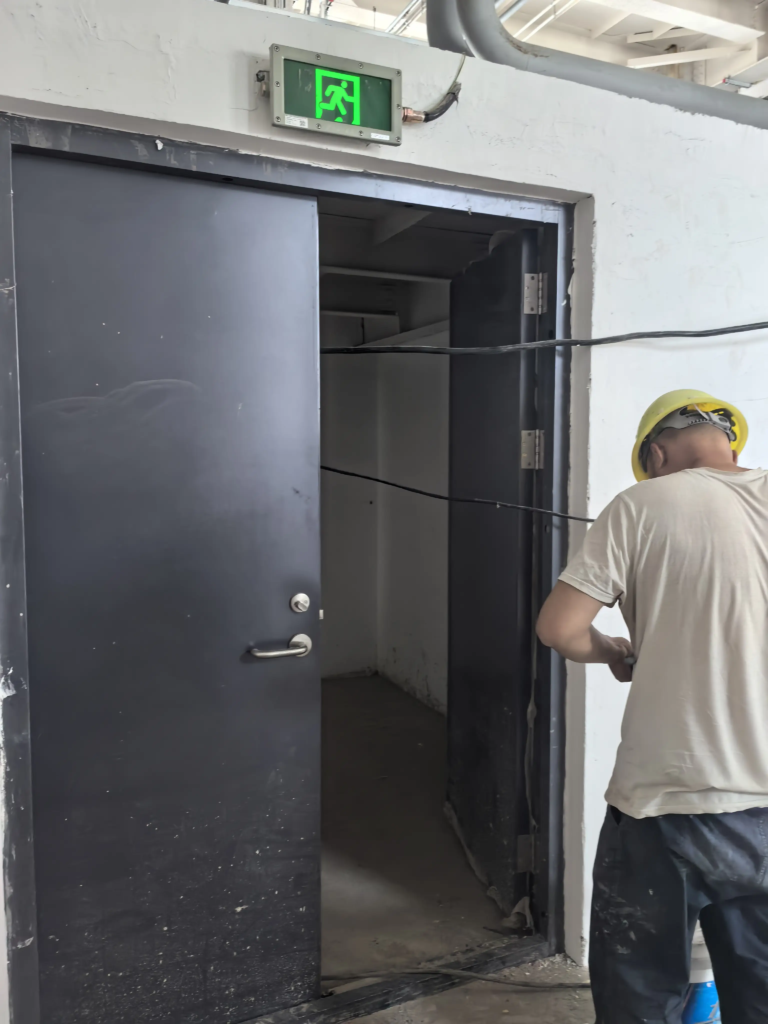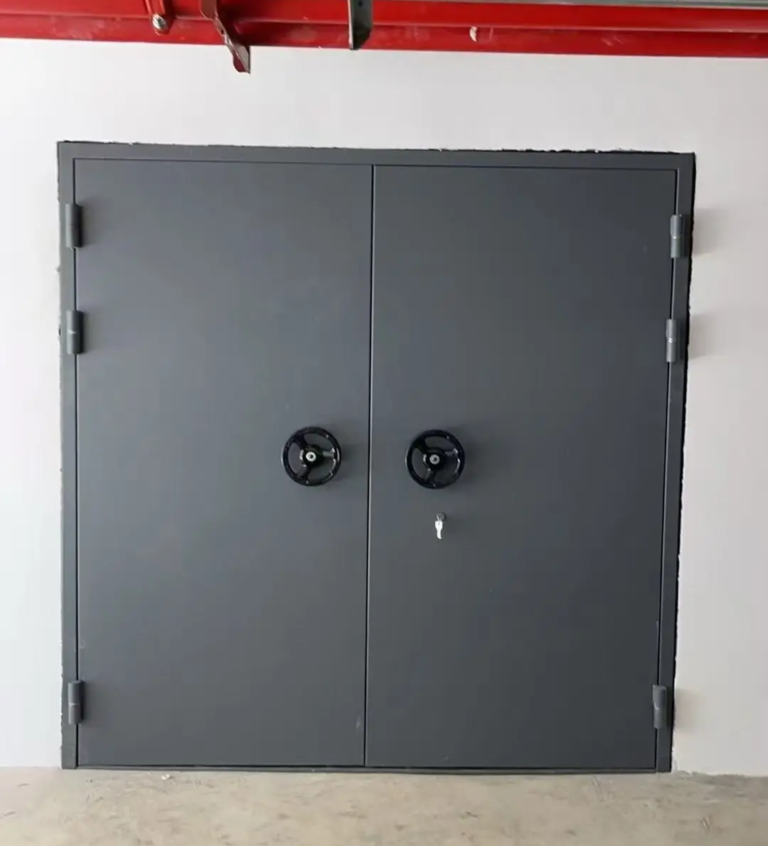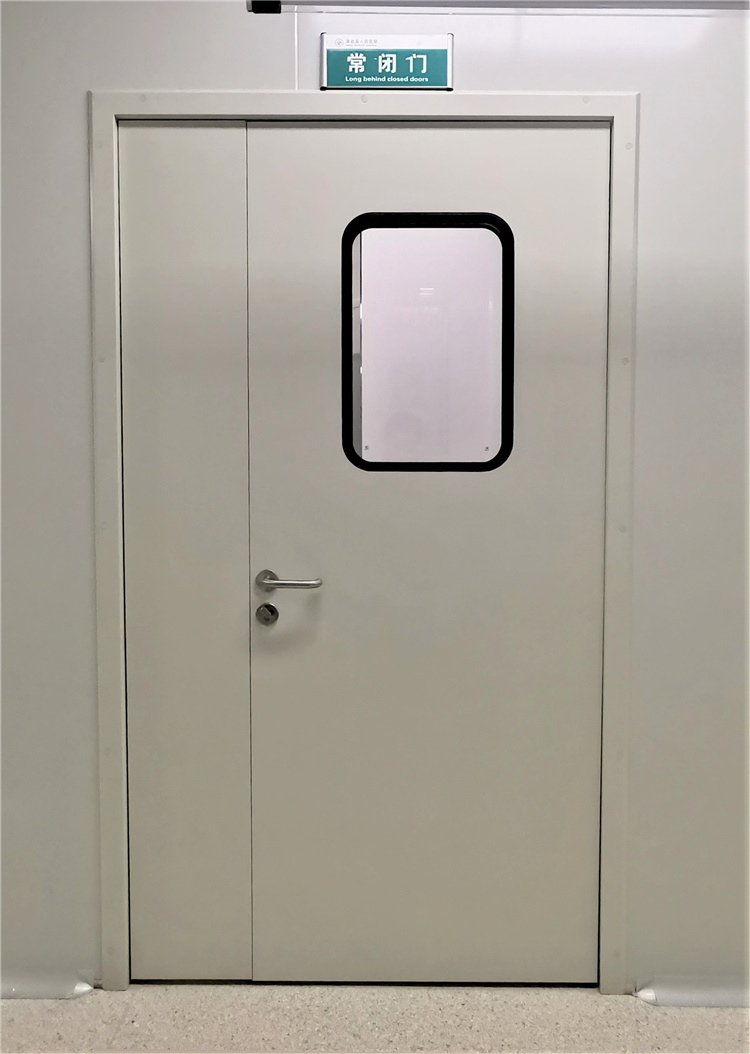
Fire doors for nuclear power plants and power stations are specialized door assemblies that, on top of conventional fire integrity and thermal insulation, are reinforced to withstand special operating conditions such as nuclear radiation shielding, chemical corrosion, and salt-fog attack. The technical core lies in the integrated unification of fire resistance, radiation shielding, and corrosion resistance. Different countries have developed divergent standard systems based on their respective nuclear/power industry development paths.
1. Special Anti-Radiation Treatments for Nuclear Plant Fire Doors
1.1 Radiation-Shielding Doors (Lead-Lining Technology)
Nuclear power plants contain numerous zones requiring ionizing radiation shielding, such as the reactor containment building, spent fuel storage pool (PTR), radioactive waste treatment areas, and nuclear auxiliary building. Conventional fire doors cannot block X-rays or γ-rays; therefore, lead-lined fire-rated doors must be employed.
| Technical Parameter | Specification Range | Remarks |
|---|---|---|
| Lead equivalence (Pb eq.) | 1/32″ (approx. 0.8 mm) to 200 mm Pb | Diagnostic X-ray rooms typically 1–3 mm Pb; reactor areas may reach 50–200 mm Pb |
| Door leaf thickness | 44 mm (1¾”) to 500 mm | Thicker lead layers increase door weight, requiring heavy-duty hinges and automatic drive systems |
| Door body material | Hollow metal (steel) or solid timber core | Steel used for high lead equivalence (>1/8″); timber for low lead equivalence and medical areas |
| Fire rating | 30 min (FD30) to 120 min (FD120) or UL 90 min | Must pass EN 1634-1 / BS 476-22 / UL 10C fire resistance tests |
| Lead purity | ≥ 99.9% | High-purity lead sheet embedded in the door core; lead layer must cover the full height and width of the leaf |
| Door frame | 16-gauge (approx. 1.5 mm) cold-rolled steel, lined with equivalent lead layer | Ensures no radiation leakage at the leaf-to-frame junction |
The core difficulty of lead-lined doors lies in the compatibility between fire resistance and shielding: lead has a melting point of approximately 327 °C and will soften or even melt under fire high temperatures. Therefore, the lead layer must be encased in non-combustible core material (such as expanded perlite or ceramic fiber) and employ a special structure to prevent lead loss at high temperatures. A lead-lined radiation-proof overlap must be provided between the door leaf and frame, typically using a continuous hinge system to maintain long-term alignment.
1.2 Neutron-Shielding Doors
In reactor containment buildings and linear accelerator (LINAC) areas, in addition to γ-rays, neutron radiation is also present. Neutron-shielding doors employ a composite shielding structure:
- Inner layer: Borated polyethylene (BPE), for moderating and absorbing thermal neutrons
- Outer layer: Lead sheet or high-density concrete, for shielding secondary γ-rays
- Door weight: A single leaf can reach 1,200–40,000 lb (approx. 540 kg–18 t), requiring industrial-grade electric sliding rail systems
Such doors are typically designed as industrial sliding doors, coordinated with automatic trench cover systems to ensure that floor gaps are also shielded.
1.3 Sealing and Gas Tightness
Nuclear plant fire doors must also possess gas tightness to prevent leakage of radioactive aerosols or corrosive gases (such as boric acid vapor or hydrogen) through door gaps. The perimeter of the door leaf is typically fitted with:
- Intumescent fire seals (expand when heated to block flame and smoke)
- Lead-lined door sweeps (Lead Shielded Door Sweep)
- Multiple rubber sealing rings (maintain gas tightness under normal conditions; intumescent seals take over during a fire)
2. Special Anti-Corrosion Treatments for Nuclear Plant Fire Doors
The internal environment of nuclear power plants features high humidity, high salinity (seawater cooling systems), and chemical cleaning agent residues, requiring specialized anti-corrosion treatment for fire doors.
2.1 Material Selection
| Material | Cr / Ni / Mo Content | Applicable Environment |
|---|---|---|
| SUS304 (06Cr19Ni10) | Cr 18%, Ni 8%, no Mo | General indoor dry areas, routine nuclear auxiliary buildings |
| SUS316 (06Cr17Ni12Mo2) | Cr 18%, Ni 10–14%, Mo 2.5% | Near seawater cooling systems, high-salt-fog areas, chemical treatment rooms |
| SUS316L | Low-carbon version of SUS316 | Welded joints, to prevent intergranular corrosion |
Because SUS316 contains molybdenum (Mo), its resistance to pitting corrosion in chloride ion (Cl⁻) environments is significantly superior to SUS304. In nuclear plant areas served by the essential service water system (SEC) and the component cooling water system (RRI), which use seawater, the door body and hardware are typically mandatorily required to be SUS316 or SUS316L.
2.2 Surface Treatment
- PVDF / KYNAR 500 fluorocarbon resin coating: Applied over SUS304 substrate to form a dual anti-corrosion barrier, resistant to salt fog, ultraviolet radiation, and chemical solvents, with a design life exceeding 20 years. Application examples include the Linkou Power Plant and Taichung Power Plant in Taiwan.
- Passivation treatment: Stainless steel undergoes acid pickling and passivation after manufacture to enhance the integrity of the surface chromium oxide film.
- Avoid direct contact between carbon steel and stainless steel: To prevent galvanic corrosion (dissimilar metal corrosion).
3. Special Anti-Corrosion Treatments for Thermal Power Plant Fire Doors
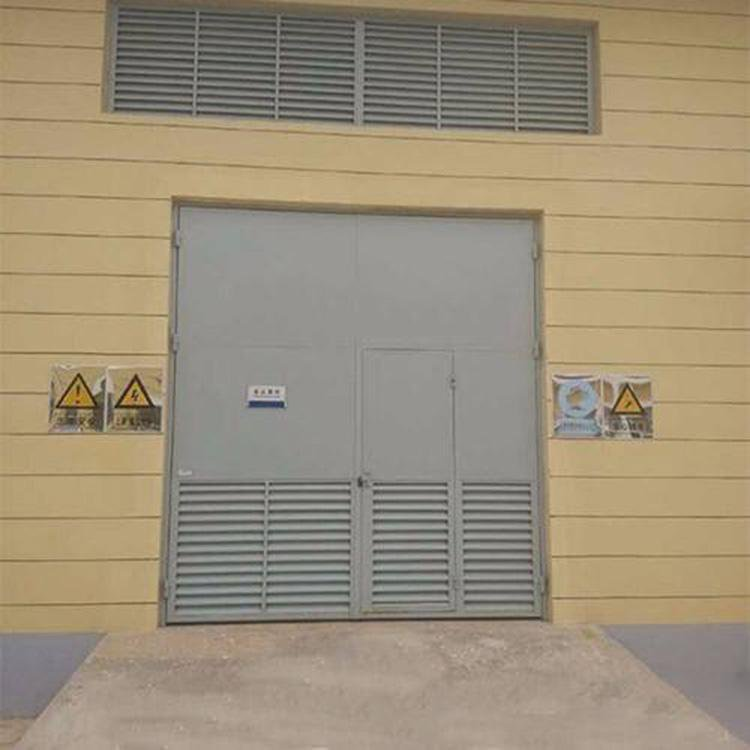
Thermal power plants (especially coal-fired, gas-fired, and coastal plants) have no radiation-shielding requirements for their fire doors, but face special operating conditions such as coal dust, flue gas corrosion, salt-fog attack, and oil contamination.
3.1 Salt-Fog Corrosion in Coastal Power Plants
In thermal power plants using seawater cooling (e.g., coastal power plants), fire doors in areas such as the turbine hall, circulating water pump house, and seawater desalination workshop are exposed to high-salt-fog environments for long periods:
- Material: Door leaf panels employ SUS316 or galvanized steel with epoxy coating
- Coating: Epoxy zinc-rich primer + fluorocarbon topcoat, with total dry film thickness typically ≥ 200 μm
- Hardware: Hinges, locks, and door closers employ SUS316 or nickel-plated surface treatment
3.2 Chemical Corrosion in Flue Gas Desulfurization (FGD) Areas
Desulfurization and denitrification areas contain acidic gases such as SO₂, SO₃, and NOx, as well as limestone slurry splash:
- Door bodies employ acid-resistant stainless steel or carbon steel with glass flake coating
- Seals must be acid-resistant; ordinary rubber (prone to aging by SO₂) is prohibited
3.3 Fire and Oil-Contamination Resistance in Fuel and Oil System Areas
Areas such as the turbine hall main oil tank, lubrication oil system, and fuel oil pump room:
- Door surfaces must be easy to clean and resistant to oil adhesion
- Smooth metal panels (such as SUS304 brushed finish or powder-coated surface) are employed; timber doors are avoided because oil absorption creates a fire hazard
- Per GB 50229-2019 (China) or NFPA 850 (international), transformer rooms, cable mezzanines, and battery rooms must use Grade B or Grade A fire doors opening in the direction of egress
4. Core Standard Systems and Rationale Analysis
The standard systems for nuclear and power plant fire doors did not emerge in a vacuum; they are products of each country’s nuclear/power industry development path. The following traces the historical rationale of the major standards.
4.1 U.S. System: Transition from Prescriptive to Performance-Based Fire Protection
4.1.1 IEEE 603 — “Independence and Reliability” Criteria for Nuclear Safety Systems
Rationale: After the 1979 Three Mile Island (TMI-2) accident, the U.S. Nuclear Regulatory Commission (NRC) profoundly recognized the insufficient reliability of nuclear plant safety systems (including fire protection systems). Previously, electrical protection systems in U.S. nuclear plants were governed by IEEE 279-1971 Criteria for Protection Systems for Nuclear Power Generating Stations. In 1991, IEEE expanded the scope to cover complete “safety systems” (Safety Systems), publishing IEEE 603-1991, which was subsequently mandated by the NRC into 10 CFR 50.55a.
Core logic: IEEE 603 does not directly prescribe door leaf thickness; rather, it prescribes that safety-class equipment (including fire doors and their control circuits) must satisfy independence, single failure criterion, and testability. This means that if a nuclear plant fire door is part of the safety system (e.g., a reactor building fire barrier), its electrical control, door closer, and signal feedback loop must undergo environmental qualification per IEEE 603. In 2025, the NRC further proposed incorporating IEEE 603-2018 into regulations to strengthen defenses against common cause failure (CCF).
4.1.2 NFPA 805 — Birth of a Performance-Based Fire Standard
Rationale: In the 1990s, the U.S. nuclear industry grew increasingly dissatisfied with the NRC’s traditional prescriptive fire protection requirements (10 CFR 50.48 Appendix R, i.e., “one-size-fits-all” fire barrier, detection, and suppression system configurations), viewing them as excessively conservative and costly. In 1997, the NRC proposed the “Risk-Informed, Performance-Based (RI-PB)” regulatory concept; NFPA volunteered and published NFPA 805 in 2001, superseding the earlier NFPA 803.
Core logic: NFPA 805 no longer prescribes “how thick a fire wall must be or how many extinguishers are required.” Instead, it requires nuclear plants to demonstrate through Fire Probabilistic Safety Assessment (Fire PSA) and Fire Hazard Analysis (FHA) that their fire protection scheme can achieve four objectives:
- Nuclear safety (reactivity control, fuel cooling)
- Prevention of radioactive release
- Personnel life safety
- Reduction of equipment damage/outage
In 2004, the NRC amended 10 CFR 50.48(c), allowing nuclear plants to voluntarily adopt NFPA 805 in lieu of traditional Appendix R. This was a landmark event in global nuclear fire protection, marking the transition from “prescriptive” to “performance-based” regulation.
4.2 French System: RCC-E and an Independent Nuclear Industry Path
Rationale: France massively developed pressurized water reactors (PWRs) during the 1970s–1980s, forming an indigenous regulatory system independent of U.S. ASME. In 1987, the French Association for Design, Construction and In-service Inspection of Nuclear Island Equipment (AFCEN), under the leadership of Électricité de France (EDF), published RCC-E Design and Construction Rules for Electrical Equipment of the Nuclear Islands.
Core logic: RCC-E is not merely an electrical standard; it covers the entire lifecycle of design, manufacture, qualification, and installation of all electrical and I&C equipment in the nuclear island. For fire doors, if they are equipped with electric door closers, electromagnetic releases, or fire signal feedback devices, and are installed in safety-class zones, then the door body and its control circuit must undergo equipment qualification per RCC-E, including:
- Irradiation aging tests
- Thermal aging tests
- Seismic qualification tests
- Post-loss of coolant accident (LOCA) environmental tolerance tests
RCC-E and the U.S. IEEE 323 form parallel systems: the former serves the French EPR reactor type, the latter serves U.S. and most international projects. China’s Taishan Nuclear Power Plant (EPR) and Finland’s Olkiluoto plant both employ the RCC-E system.
4.3 International System: IAEA Safety Standards as a Harmonizing Force
Rationale: The International Atomic Energy Agency (IAEA) does not directly formulate door manufacturing standards. Instead, through safety standards such as SSR 2/1, SSG 30, and SSG 34, it establishes “top-level safety objectives” for all countries.
Core logic: The IAEA requires that “materials in contact with radioactive effluents must possess anti-corrosion characteristics to avoid direct contact between carbon steel and radioactive products; polymeric materials shall be radiation-resistant.” This explains why nuclear plant fire doors prohibit the use of bare carbon steel, and why seals and coatings must pass irradiation aging tests. When formulating national regulations, each country must demonstrate that its standards are no lower than IAEA safety objectives.
4.4 Chinese Thermal Power System: Evolution of GB 50229
Rationale: China’s thermal power plant fire protection design code has undergone three iterations: GB 50229-1996 → 2006 → 2019. Early versions mainly drew on Soviet and U.S. NFPA experience; the 2019 edition absorbed engineering practice from domestic ultra-supercritical units, large substations, and nuclear plant conventional islands.
Core logic: GB 50229-2019 provisions on power plant fire doors are oriented toward building fire protection (fire ratings, fire compartments, egress distances) rather than the equipment qualification approach of nuclear plants. For example:
- Transformer rooms, switchgear rooms, cable mezzanines: Grade B fire doors
- Cable tunnel fire walls: Grade A fire doors
- Main workshop partition walls: Grade B fire doors
For corrosion resistance, GB 50229 only generally requires that “door bodies in corrosive environments shall adopt anti-corrosion measures”; specific material selection is determined by project environmental conditions. Coastal plants typically supplement the design specifications with requirements for SUS316 or PVDF coatings.
5. Comparison Table of Major Standards
| Standard | Issuing Body | Applicable Object | Core Emphasis | Historical Rationale |
|---|---|---|---|---|
| IEEE 603 | IEEE | Nuclear plant safety systems (including fire door control circuits) | Single failure criterion, independence, CCF defense | Post-TMI, NRC mandated enhanced safety system reliability |
| NFPA 805 | NFPA | Light-water reactor nuclear plant fire protection systems | Performance-based fire protection, Fire PSA, FHA | NRC promoted RI-PB regulation to replace prescriptive Appendix R |
| RCC-E | AFCEN (France) | Nuclear island electrical and I&C equipment | Equipment qualification (irradiation, thermal aging, seismic, LOCA) | France’s independent PWR technology system, serving EPR reactors |
| IAEA SSR 2/1 | IAEA | Top-level framework for national nuclear safety regulations | Material corrosion resistance, radiation resistance, leak prevention | Coordinating standard under international nuclear safety conventions |
| 10 CFR 50.48(c) | NRC | U.S. nuclear plant fire protection licensing basis | Voluntary adoption of NFPA 805 permitted | U.S. nuclear industry reform诉求 against overly conservative prescriptive requirements |
| GB 50229-2019 | Chinese Ministry of Housing and Urban-Rural Development | Thermal power plants and substations | Building fire compartments, fire ratings, egress | Development of China’s power industry and ultra-large unit experience |
| NFPA 850 | NFPA | All types of power plants (thermal/hydro/nuclear) | Fire suppression system configuration, fire detection, extinguishing | General fire protection recommended practice for U.S. power generation |
| EN 1634-1 / BS 476-22 | CEN / BSI | Fire door fire resistance testing (globally adopted) | Fire integrity, thermal insulation | European building fire testing tradition, widely adopted in Middle East and Asia |
Summary
The anti-radiation treatment of nuclear plant fire doors centers on lead lining and composite neutron shielding; anti-corrosion relies primarily on SUS316/316L stainless steel and PVDF coatings. Thermal power plants focus on corrosion protection against salt fog, flue gas, and oil contamination. The standard logic behind the two systems is fundamentally different:
- U.S. nuclear fire protection evolved from IEEE 279 (1971) → IEEE 603 (1991) for safety system reinforcement, and from Appendix R (prescriptive) → NFPA 805 (performance-based) for regulatory philosophy transformation;
- French nuclear fire protection relies on RCC-E, following an independent equipment qualification path that emphasizes full-lifecycle environmental tolerance;
- Chinese thermal power is represented by GB 50229, focusing on building fire protection engineering, with anti-corrosion measures specified according to project environmental conditions.
Fire door enterprises exporting to the Middle East, Europe, or participating in EPR projects must simultaneously understand the differences among EN 1634-1 (testing baseline), NFPA 805 (U.S. nuclear performance-based logic), and RCC-E (French qualification logic) in order to accurately match the compliance pathways of different clients.